


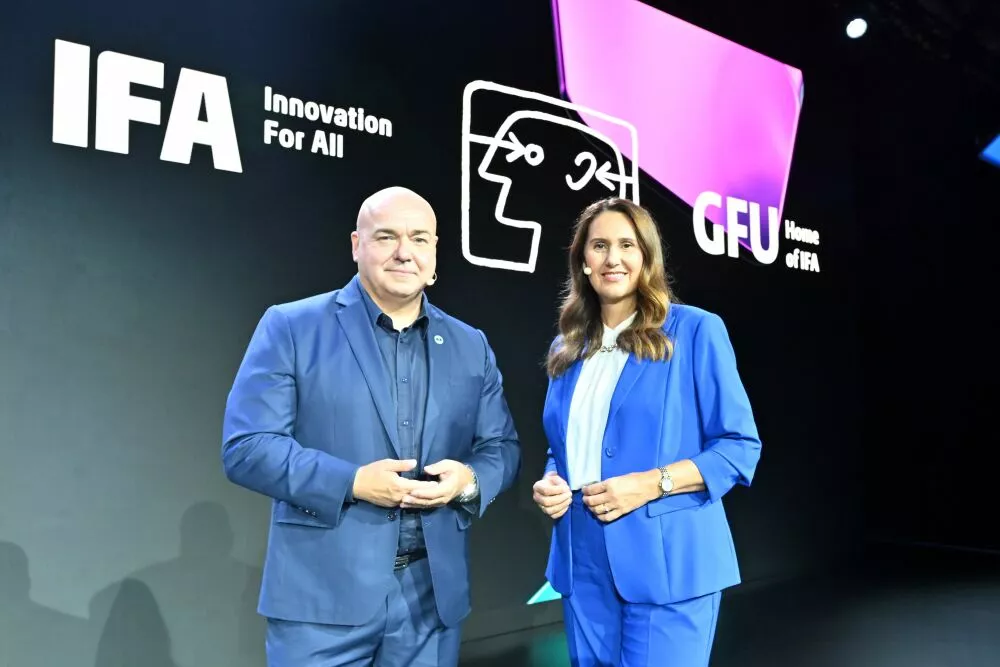
IFA Berlin, the world’s largest event for Consumer Electronics, Home Appliances and Future Tech, opens its doors for the IFA Media Days ahead of the official start of the show. At the IFA Opening Press Conference, Leif Lindner, CEO of IFA Management, focused on the rapid development of artificial intelligence and robotics and their impact on the economy, society and everyday life. Concluding the conference, Carine Chardon, Managing Director of GFU Consumer & Home Electronics GmbH, presented global developments and trends in the technical consumer goods industry.
AI is transforming everyday life and creating new markets
In his opening speech, Leif Lindner described a technological development progressing faster than previous industrial transformations. Artificial intelligence is no longer learning only to create content and solve complex tasks. It is increasingly beginning to operate in the physical world. At the same time, smaller and more energy-efficient AI models are moving directly into smartphones, vehicles, home appliances and other everyday products.
“The future is no longer something on the distant horizon. The future is now. But technology alone does not create progress. It only reaches its full potential when people can understand it, try it out and help shape it. That is exactly what IFA stands for: We make innovation tangible and provide guidance at a time when technology is changing faster than ever before”, says Leif Lindner, CEO of IFA Management.
IFA makes technological transformation tangible
Over the coming days, visitors to IFA can experience how AI and robotics are already being used today. At RoboCup, autonomous robots compete against one another in football matches. At “Robots on the Runway”, humanoid and entertainment robots demonstrate how technology, movement and entertainment are converging.
IFA also brings technology together with culture, business, politics and society. Formats such as the Retail Leaders Summit, the new Retail Innovation Zone, the Smart Living Forum and IFA Next connect international brands, start-ups, retailers, researchers and political decisionmakers. With IFA Moments, the IFA Creator Hub and live podcasts in the Sommergarten, IFA also takes discussions about technology beyond the exhibition halls.
Global Tech & Durables market grows to USD 430.5 billion
IFA is now also reaching the next generation: One in two private visitors is under the age of 35. Around two-thirds of visitors return to IFA.
According to GFU Consumer & Home Electronics, the global technology and durable goods market remains resilient despite geopolitical tensions, persistent inflation and significant pressure on supply chains. In the first half of 2026, global revenue (excluding North America and Russia) rose by 6.0 percent to USD 430.5 billion.[1]
Adjusted for currency effects, growth was more moderate at 2.4 percent. Part of the nominal increase in revenue was attributable to exchange-rate effects, particularly movements in the US dollar. Growth is being driven primarily by premium products that offer clear added value and make everyday life easier. In many categories, consumers are purchasing more consciously and keeping devices for longer. At the same time, they are willing to invest more in innovative features, better performance and convenience.
The global balance of power is shifting
Emerging Asian countries outside China are among the global growth drivers, recording double-digit growth of 12 percent in the first half of the year. As global supply chains diversify, Southeast Asian countries in particular are benefiting by establishing themselves as exporters of AI technology and hardware components. The Middle East and Africa are also showing positive momentum, with the market growing by 15 percent in the first half of the year.
Small domestic appliances continue to lead market momentum
Once again, small domestic appliances proved particularly dynamic. They led the Tech & Durables market in the first half of the year with growth of 5 percent. Telecommunications products followed with global growth of 4 percent, while Consumer Electronics grew by 2 percent.
At product level, particularly strong performers included freestanding “Space-Fit” refrigerators designed to integrate visually and functionally into modern kitchens, as well as washing machines with steam-cleaning modes, portafilter espresso machines, robot vacuum cleaners, AI PCs with integrated processors for local AI applications, and televisions with a screen size of 75 inches or larger.
Three future themes are shaping the next phase of growth
Products featuring artificial intelligence, robotics that make everyday life easier and next-generation wearables are emerging as key areas of growth potential for 2026.
“The market is stronger than current sentiment would suggest. Targeted innovations that make consumers’ everyday lives easier, improve energy efficiency or open up new possibilities for use are crucial to growth. The future of the technical consumer goods market is therefore being shaped not only by technology, but above all by the ability to translate innovation into tangible benefits for everyday life. All of these topics, together with the related products and developments, can be seen and experienced at IFA 2026 over the coming days,” explains Carine Chardon, Managing Director of GFU Consumer & Home Electronics GmbH.
Preview: Thursday’s IFA highlights
On the second day of the Media Days, Thursday, September 3, 2026, visitors can look forward to numerous keynotes, product launches and live experiences. Find all the highlights for tomorrow here: IFA programme for September 3, 2026.
IFA Images
You can find IFA 2026 images here: Media Galleries | IFA Berlin 2026 – Innovation For All
To know about more such tech-related information, check out our website: